
Reading Analysis:
Coleman not only describes the role of blacks in horror films, but she also acknowledges the role that race, specifically African Americans, in film as a whole. She dives into the horror genre specifically, saying that horror is meant to disrupt the natural order of a hegemonic rational, evoke fear, upset the validity of rationality. She describes the roles of Blacks in horror films as a disrupt into the whiteness in everyday society as the majority of horror films in the beginning where shaped and created by white men. The roles of Blacks begs the question if the racial difference is to lend itself to the otherness of the antagonist, portraying a savage stereotype of the people, or can Blacks exist in horror films just to be a character? Coleman then makes the remark that is scarcely seen that Blacks are often portrayed in the horror genre, and if they are, their otherness against the bourgeois, patriarchal, white status quo is often played for some antagonistic or minor role.
Coleman also describes that a lot of the founding fathers of the slasher genre are set in the suburbs, an area that is not often populated by black individuals, so films like Halloween or Nightmare on Elm Street may not have black actors cast because it doesn’t make sense socioeconomically. Coleman when describing the role of the Blacks in horror cannot just exist in the narrative like a white character can without making some notion towards race, oppression, or inequity, whether it be portrayed through an antagonist or protagonist lens.
In Pinedo’s reading, she demonstrates the way race is depicted in horror films. Pinedo recognizes the absence of race diversity in horror films with the majority of horror films being filled with a majority all white cast and creative team, funding by all white run studios. Pinedo states the postmodern horror films’ terrors linger in a place that is unexpected to find any otherness, such as the middle class suburbs or a summer camp, straying away from the gothic formula of either a castle or a mad scientist’s castles. This removes the buffer between the anxieties and fears present in the urban cities where more racial groups are prevalent, leading to the creation of urban horror.
Pinedo goes on to address and examine the presence of race in horror films, whether it is there intentionally, to support the protagonists, or to be the antagonist. She says the monster is most likely to be constituted as a racial other when the horror film expands into urban adventures in big, crime-filled cities, like Chicago, New York, or Los Angeles, where more racial minorities are present and operate in America.
Candyman Film Analysis:
This was definitely a movie that was assigned for class. Let’s get that out of the way.

Throughout Candyman, Helen is exposed to the systematic and generational trauma that the people in the projects experience due to the wrath of Candyman. It’s wrong to say, but it is clear that in the move that Helen lives in the nicer part of the city. “Because it seeks to disrupt everyday life and supplant security with paranoia, the genre locates the monster in an ideologically safe environment: the rural, innocent pastoral realm, or the suburb, the buffer zone removed from, and in opposition to the city, signifier of corruption” (Pinedo 112). The urban horror of Candyman seeps into the pristine, whiteness of the clean, modern part of the city after Helen research follows her home, finding horror in unexpected places and disrupting the status quo. This curse of systematic racism follows Helen and invades the lives of her white husband and “white-washed” black friend. “What is observed here is that in many instances violence in Blackness and horror function together to provide important discursive inroads, such as violence as exhibiting a sort of ‘return of the re/oppressed’” (Coleman 5). The Candyman exists during this point in time because a white woman believes in him, rather than taking the words of the black people in the ghettos who have been experiencing race based crimes for years now. Helen had to witness the Candyman one time, and she gets all the attention; however, these black people have been witnessing these crimes against their loved ones, and no one in power batted an eye because this was nothing new to these people.

Candyman, while having a black man in one of the lead roles, reinforces the stereotype of black people being portrayed as a ‘boogeyman.’ “The pro-Ku Klux Klan, Civil War epic The Birth of a Nation (1915) is one film that soundly casts Blacks as horrific figures-they are monstrous, savage boogeymen (often, literally men) with troublesome cultural practices” (Coleman 7). The Candyman does unspeakable things to his own people and terrorizes Helen and her loved ones, and he does without reason other than for revenge. However, he is getting revenge on the wrong people and is creating a fear that continues throughout the community and spreads to become this urban legend. “At the end of Night, Ben’s body is unceremoniously burned in a bonfire, the film’s last image of fire, one that suggests the Klan’s use of fire to rule by terror” (Pinedo 114). At the end of the film, Helen burns to death. Yes, she is white, but her death reinforces the symbolism of the oppressed burning for their existence. It’s the reminiscent of the KKK imagery that assists with the racism and wrongful writing that is present throughout the entirety of Candyman.
It should also be noted that the Candyman is not just a legend, but he has to be an urban legend because his believers mainly reside in the ghettos, and he himself is black. “Considering that a sexist society perceives battered women who kill in self defense as criminal, if not monstrous, and that a racist society appraises aggressive black men (and sometimes women) as criminals, if not monsters, then is there not some pleasure and sense of power to be gained, at least by female and black audience members,“ from seeing the power in these violent figures?” (Pinedo 131). Candyman gets its diversity points for having a black man be in the spotlight, but that’s about where the progressiveness ends because all other characteristics reinforce harmful stereotypes about black people and their culture. “For example, Brown categorizes Black character types frequently seen in early twentieth century mainstream literature, such as the ‘content slave’ or the ‘wretched freeman’” (Coleman 2). The portrayal of black individuals in Candyman can never leave the state of the impoverished, oppressed individual in the ghettos or the content slave, like Candyman was the artistic entertainer for the white folks of his time.
Get Out Film Analysis:
There’s something to be said about the authenticity of stories when they are told by the people they are about. Where Candyman had a white creative team writing about the black experience, Get Out has Jordan Peele leading a triumph of modern day American cinema, and Get Out reveals the racism that goes unnoticed in America society.

The movie is set in the secluded home of the Armitage family. “What I have found is that horror films which violate this convention of whiteness also violate another convention of the genre: they are usually set in the city rather than the suburban or rural retreat favored by con temporary horror films” (Pinedo 112). Here, Get Out follows the ‘horror in a places it shouldn’t be’ troupe, but this cliche is flipped on its head. The majority of horror films that take place in places like the suburbs (areas where it is seemingly safe) have a majority white cast. “Horror films avoid locating monstrosity in the city where violence is, as a matter of public record, a routine element of everyday life” (Pinedo 112). Peele recognizes that the horrors of racism are present not just in the city but also in every aspect of the black man’s day to day life, using the Armitages as a deception. They are the model neoliberal family, supportive of their daughter’s interracial relationship and educated and interested in Black culture, but it’s all of facade of their philosophy of the disposal of the African American and their cultures for their own personal and financial gain. The Armitages run a slave trade system from their backyard via the facade of a silent bingo. It’s really a silent auction, selling Chris to wealthy white elders. It’s the silent racism and the disposal of one man’s identity as he is stripped away from capital. “It is a problem that is still exacerbated by a ‘sense of always looking at one’s self through the eyes of others, of measuring one’s soul by the tape of a world that looks on in amused contempt and pity’” (Coleman 9). Chris is in danger of his body becoming someone else’s. His eyes would not be his own, and he would be competing for the right to run his own body against a white person who bought his way in there. These white people are actually taking their souls and putting them in black people’s body to look at one’s self through the eyes of others. “It cannot be ignored that physical and emotional violence are often central to the horror film genre” (Coleman 5). The matriarch of the family uses the traumas that Rose’s partners have in order to silence and subdue the blackness in them to make room for the white elder to control the body through hypnosis.

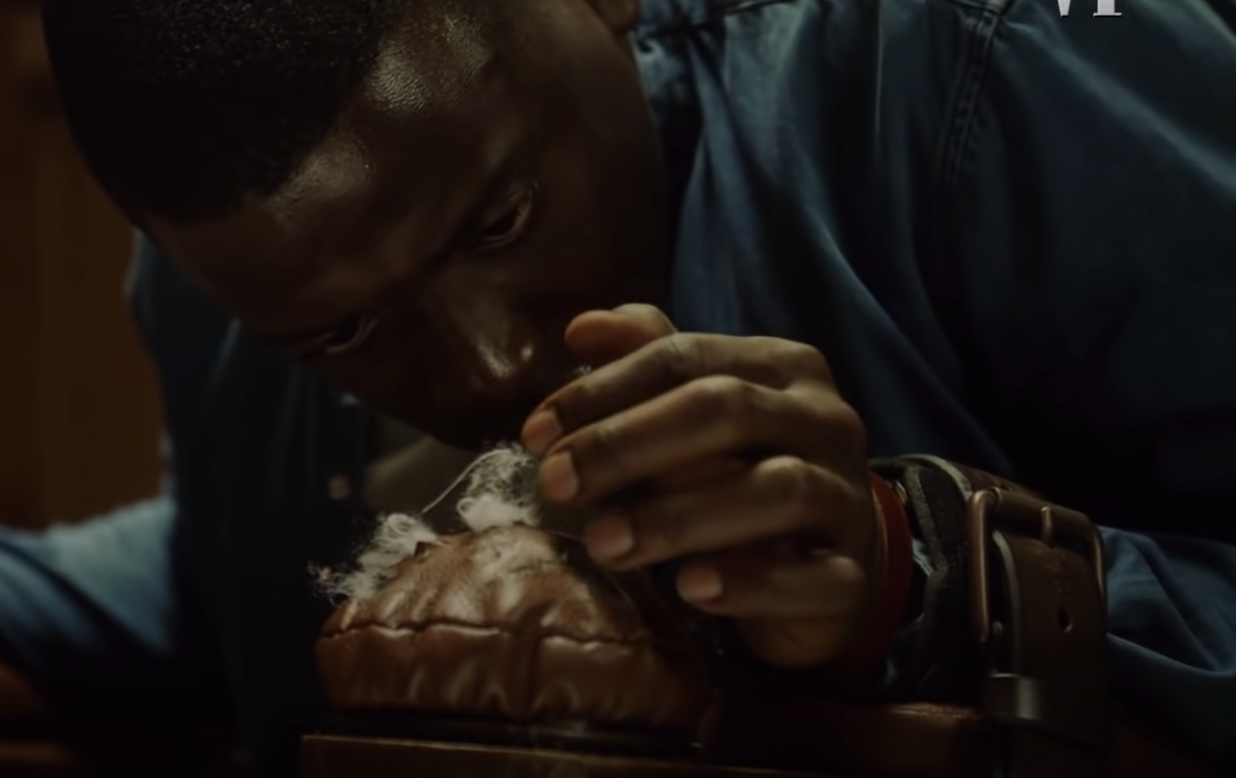
Here, Peele manages to flip something else on its head. To survive the Armitages, Chris stuffs his ears with cotton. Cotton is usually associated with the crop that was harvested by slaves pre-Civil War, but in this scene, Chris uses it to his advantage to escape the Armitages. “One film that racializes the monster as white, and that draws on the social conditions of the inner city ghetto, is not included in my group of race horror films because it unfolds not within an urban environment, but inside a large house” (Pinedo 114). The Armitage house, like the family itself, has more than meets the eye. The house is fairly large from the outside, but the intricacy of its character evolves when the audience explores the underground portions. The overarching theme of Get Out is the appearance and facade of individuals. “Isabel Christina Pinedo, in Recreational Terror: Women and Pleasure of Horror Film Viewing, capably synthesizes the range of horror considerations, defining the genre according to five key descriptors: (1) horror disrupts the everyday world; (2) it transgresses and violates boundaries; (3) it upsets the validity of rationality; (4) it resists narrative closure; and (5) it works to evoke fear” (Coleman 4-5). Get Out upsets the natural order of society’s natural appearance and disrupts the boundaries that the audience has. The Armitages appear interested in Chris and his culture, but then the viewer learns that it’s not for the right reasons. The house appears to be a wealthy house, but when the viewer is introduced to the basement, it is to be understood that the Armitages are using their wealth, power, and status for evil and their own personal gain.
Leave a Reply