
Reading Analysis:
It is often difficult for women to see themselves in horror films because more often than not horror films only have female characters to have them act as toys to portray the filmmaker’s own demented sexual fantasies. Laura Mulvey and Linda Williams put it best in their respective articles, “Visual Pleasure and Narrative Cinema” and “When the Woman Looks.” While women may play a part in horror films , they have no agency in what happens to them. It’s plainly simple as the trend has been growing since horror films were birthed. Women are objectified and tortured for the sake of voyeuristic pleasure. At times, the audience understands or has a better understanding of what is happening during the film than the female protagonist. Whether it is the killer creeping up behind the woman’s back or the audience being a third wheel in a sex scene, movies are inherently voyeuristic, and the audience is just a bystander to the woman’s demise.
The woman is there to be a character, yes, but she operates more as a reverse Chekhov’s gun. A character that was significant in the beginning is now an unimportant prop in the killer’s fantasy. She might as well be replaced with a sex doll by the time she is inevitably murdered with the little significance and control she has in her own story.
One could argue the final girl subverts this stereotype male writers and directors have created as a precedent for future horror makers, but without reason or fail, the final girl must suffer the torture of losing everyone important in her life only to be toyed with and barely escape death.
The woman is an object to take part in sexual deviancy, rather than a character we can feel any other emotions than terror or sorrow for.
Film Analysis:
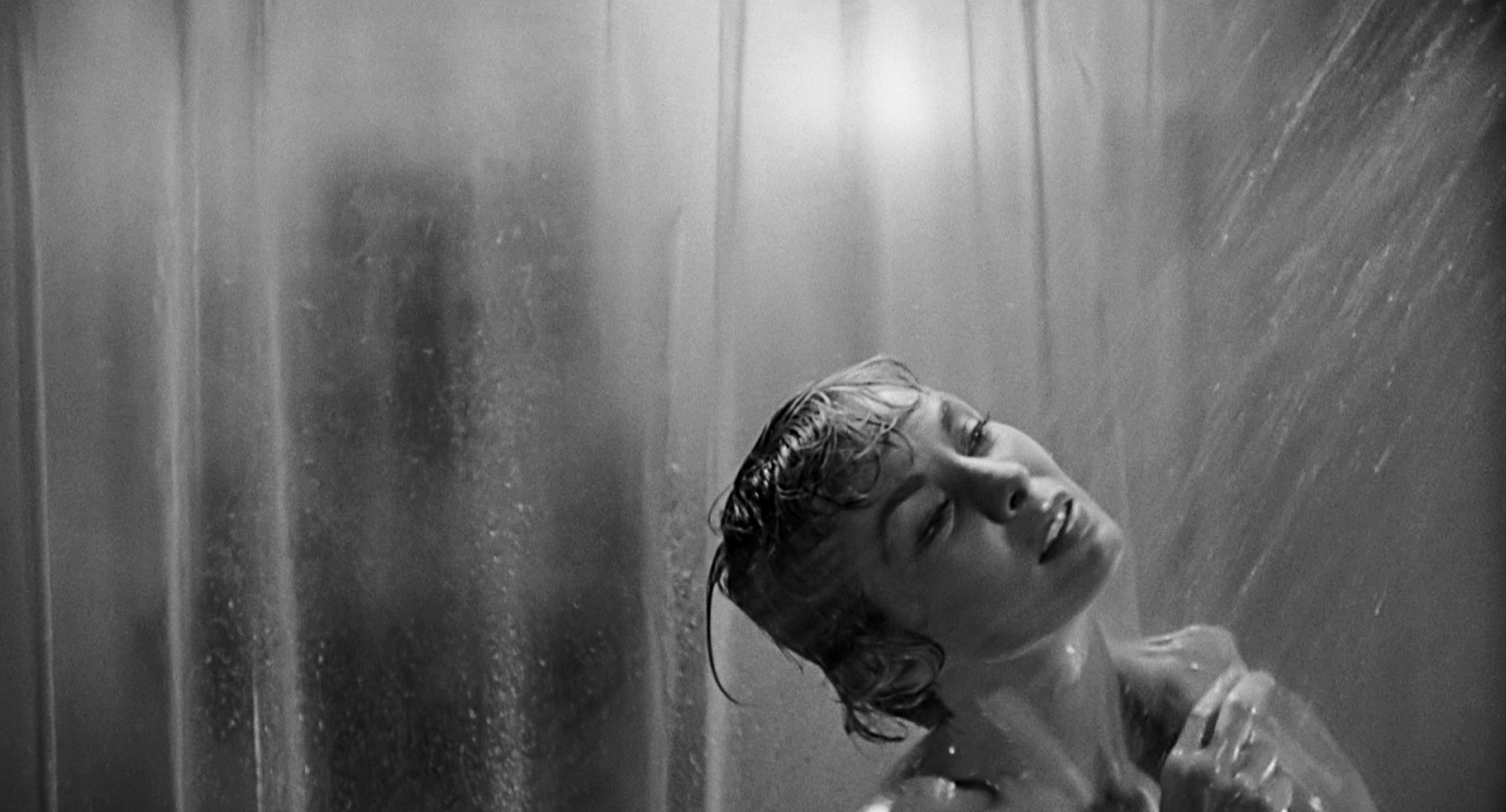
The Alfred Hitchcock classic Psycho centers around a woman on the run who goes missing at the infamous Bates Motel and the asocial innkeeper, Norman Bates and his ill mother, Norma. Out of courtesy, one should give the woman’s name, Marion; however, it does not feel necessary to do so as she is quickly offed by Norman in a gruesome and exploitive way. As stated by Williams, “The woman’s gaze is punished, in other words, by narrative processes that transform curiosity and desire into masochistic fantasy” (Williams 19). Marion is taking a shower after several tedious days of traveling when Norman, disguised as Norma, intrudes on her, naked, in the shower, a very intimate and vulnerable where the person in the tub touching themselves to become clean or “pure.” This not only touches on the issue of the objectification of women in horror cinema but also takes into count Mulvey’s thesis. Mulvey notes the recognition of voyeurism starts with Freud by saying “His particular examples center around the voyeuristic
activities of children, their desire to see and make sure of the private and the forbidden (curiosity about other people’s genital and bodily functions, about the presence or absence of the penis and, retrospectively, about the primal scene)” (Mulvey 3). No, Marion is not a child, but there is something to be said about the innocence of a shower. It is an intimate act that one performs with oneself on a daily and could easily be misconstrued as sexual or pleasurable as seen her in this shot below. “But even when the heroine is not literally blind, the failure and frustration
of her vision can be the most important mark of her sexual purity” (Williams 18). Marion is washing herself, a symbol of being clean and pure in this intimate and defenseless act.

Norman creeps onto the unsuspecting Marion, giving a preview to the audience as to what is to come. Marion has no agency in this scene as she cannot see what is behind her. The only ones who have control in this scene is Norman and the audience, spectators to animalistic and deviant torture that awaits the poor woman.
Marion is a woman trapped in a man’s world. Whatever she does to survive in this film will always bring to her demise due to her sex having no say in the rules. This is very evident in the dinner scene between Norman and Marion, as Marion comments on Norman’s hobby, taxidermy.

Norman confesses that he likes the look of birds (women) rather than beast (men). It is easier to stuff them and shape them to however he wants. They are easier prey. Unfortunately for Marion, she is the bird. She is the easy target in a man’s world. She could never not be the prey in this world she is trapped in. “In their traditional exhibitionist role women are simultaneously looked at and displayed, with their appearance coded for strong visual and erotic impact so that they can be said to connote to-be-looked-at-ness” (Mulvey 4). With the bird metaphor, it shows exactly who and what Marion is supposed to be. Pretty and prey.
Even in the scene where it is revealed that Norman has a peep hole to spy on Marion, it is clearly recognized that Marion’s privacy is not her own. It is shared with Norman and the audience. Williams acknowledges this by saying, “in the classical narrative cinema, to see is to desire” (Williams 17).

Norman has this desire for Marion, which cannot be expressed properly or healthily, due to his Oedipal relationship with his deceased mother. The invasion of Marion’s is glorified, romanticized, and sexualized as she changes in public. “She is isolated, glamorous, on display, sexualised” (Mulvey 6). She is less of a person but more of an object of desire that can be interchanged if need be. She is a plaything rather than person.
Leave a Reply