
Reading Analysis:
As Alexandra West describes in “‘Not in my Movie’: The 90s
Slasher Cycle and Grrrl Power,” with 90s slashers and beyond, 90s final girls had a feminist quality infused into their persona and characteristic in their film, displaying stronger female characters; however, Carol Clover takes this a step further in her “Her Body, Himself” reading by describing the final girl only wins due to the fact that she is more “masculine” than her other female cast mates. She wins because she rejects her own femininity to defeat or subdue the terrorizing, gender confused slasher.
West describes the difficulty of 70s and 80s slasher films to be respected by critiques due to their gory and sexual nature, disliked by both conservatives and liberals. The right criticized the portrayal of provocative sex scenes and the depiction of teen consumption of drugs and alcohol. The left disliked the roles of women in the films, being problematic sex objects with no agency.
Solutions to these complaints are solutions that hold true in modern slasher cinema. Feminist ideals were ingrained into the plot line, allowing for more authentic point of views to be told through female characters by women creatives. Slashers also became self-aware of their stereotypes and cliches that have became embedded into their movies with Scream leading this “meta-ness” renaissance by creating a movie that understood the world it was in, allowing for smarter characters and parodies of the genre.
In her article, Clover says the final girl survives her friend is due to the fact that both she and the killer share two commonalities: sexual repression and gender confusion. The final girl, like the slasher, is often a virgin, unlike her female counterparts, who often meet a bloody and overtly sexualized end. The only way these two express these repressions is during the final battle, where both penetrate each other with their weapon of choice. Both suffer from gender confusion whether it stems from childhood, like Freud believes, or it is projected onto the character, like female characters having “male presenting names” like Sidney in Scream. Their similarities are more numbered than their differences; therefore, only one side of the coin can survive.
Film Analysis:
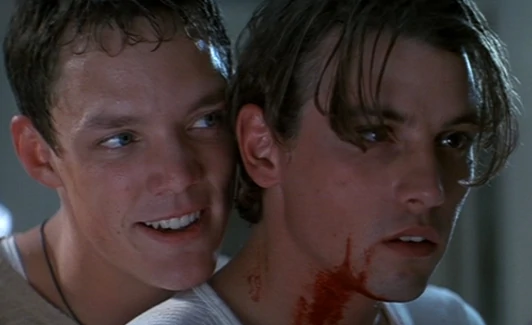
Queer bait after queer bait, Billy and Stu, the central antagonist of Scream, are no different; however, their relationship can be related back to Clover’s reading.

As Clover describes, “But the ‘certain link’ that puts killer and Final Girl on terms, at least briefly, is more than ‘sexual repression’” (Clover 96). Sidney was unwilling to put out for Billy, her boyfriend, the entire movie, due to the trauma she holds from her mother’s death. However, Stu, Billy’s best friend, is completely open to Billy. The two share a closer, more intimate relationship, arguably, than Sidney and Billy do. When it is revealed that Billy and Stu are the killers at the end of the film, Billy has a motive, where Stu does not. He’s really only doing this with and for Billy.
The two boys share an intimate moment towards the end when they are going to frame Sidney and her dad for the string of murders, both penetrating each other with a knife towards the lower abdomen. Clover describes a similar, yet heterosexual scene, in Texas Chainsaw, Part 2. “When her last assailant comes at her, she slashes open his lower abdomen—the sexual symbolism is all too clear—and flings him off the cliff” (Clover 96). While Billy and Stu are not foes, it has become a collective thought that weapons, such as knives, in slashers are a symbolic representation for the male penis and the sexual repression the killer carries with him. “What is represented as male-on-female violence, in short, is figuratively speaking male-on-male sex” (Clover 99). The delicacy and precision of both boys placing the knives in each other, making sure neither get hurt. It’s morbidly gentle, depending the twisted and tenderness of their relationship. While it is an interpretation, there is undoubtably homosexual undertones to Billy and Stu’s relationship, and in this scene particular, they show and share their sexual repressions and intimacy for each other.
It is not unreasonable to compare Billy and Stu to characters such as Louis and Lestat from the Interview with the Vampire movie (not the novels) or Mac and Dennis from It’s Always Sunny in Philadelphia. These characters share the same facade of hyper-masculinity to mask the tenderness and fondness they share for their male counterparts. It’s said that Scream breaks the mold on slasher films, but it reaffirms the system of baiting their LGBTQA+ audience.

Now, it’s not to say Scream does not subvert classic horror movie cliches. Of course it does with the ending with Gale Weathers coming to Sidney’s aid to help her take down Billy. “The Final Girls of this cycle were the products of third wave feminism, 90s alternative culture and the more mainstream ‘Girl Power’ which allowed the focus to shift to the female protagonist, her friends and their survival” (West 3). In the 70s and 80s, often times the audience would see a man coming to the aid of woman, reinstating the “norm” that the woman is dependent on the man and needs his help in order to survive. While Sidney is unable to truly defeat Billy without the help of Gale, this is seen more as a girls supporting girls rather than Sidney being subservient to Gale.

The character of Sidney is one that breaks the mold of the “pure” final girl, a precedent that was created by male creatives, the founders of the slasher genre. Here, Sidney takes control of her life and makes her own movie. “Sidney succumbed to the lure of viewing her life through the lens of mainstream (Meg Ryan) or subculture references (pornography) indulging her desire for Billy only to be taunted by his reveal as one of the killers. There is no win or gain for Sidney in playing a pre-formed role, she must create her narrative” (West 9). Throughout the film, Sidney struggles with identity and emotions due to the trauma she received from the brutality of her mother’s death. She felt guilty that she wasn’t allowing Billy the pleasure that he “deserved,” but she also felt guilty for moving on too quickly from the events. These pressures come originate from a man, Billy, who possesses and controls her life. It’s all she thinks about. It’s not until she kills Billy, a sequel (with him in it) is unable to be made. “Sidney’s definitive stance of ‘not in my movie’ offers a reprieve from the thinly worn character traits of the slashers of the 1970s and ‘80s, allowing a young woman to take control of her narrative, body and effectively dismantle what Laura Mulvey termed the ‘male gaze’ of the camera” (West 9). When Sidney relinquishes Billy’s control of her, it is only then when she is able to take control of her life. She doesn’t need to fit into some mold or a pre prescribed narrative. She only needs to fit into her own story.
Leave a Reply