
Funny how a film that is rooted in late 80s culture and societal issues still has relevance to this day. It’s almost as if Spike Lee was trying to say something about the racial tensions and inequality in America…

Do the Right Thing follows the stories of the residents of a Brooklyn neighborhood on the hottest day of the year. The weather plays a significant role in the film, paralleling the rising tensions between racial groups in America, demonstrated through the neighborhood’s clash with pizzeria owner, Sal, and his sons. As the temperatures begin to rise so does the conflict throughout the movie.

The film starts somewhat harmonious with no characters really shaking up the narrative just yet. It’s only when Mookie’s friend, Buggin Out, tells Sal to hang up some pictures of black people in his restaurant because the majority of Sal’s clientele is black. Sal refuses, thus creating a domino effect of conflict continually rising as the cultural hegemony continues to break throughout the plot. The hegemony of the film, reflecting society’s hegemony, is broken when Sal’s pizzeria in burnt to the ground by the neighborhood after the death of Radio Raheem; however, the hegemony is restored the next day when Mister Señor Love Daddy says that temperatures will continue to rise and the heat wave will not stop. In this case, director Spike Lee uses weather and heat to reflect the growing issue of racism in America and that doing one action will not stop it.

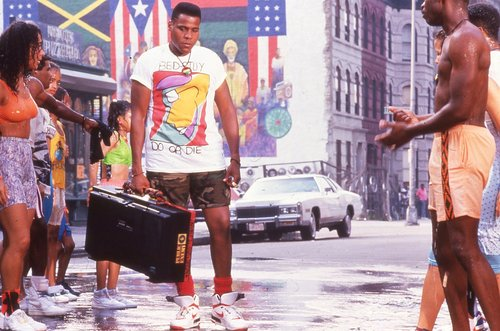
Radio Raheem’s boombox is used both as an instrumental, cultural, and metaphorical prop throughout the film. Radio Raheem plays “Fight the Power” by Public Enemy on his boombox whenever he is featured on screen to the point where this diegetic sound becomes associated with his character. This would also be seen as an instrumental prop, providing sound; however, it could be seen as a metaphorical prop due to the fact that every time Sal interacts with Radio Raheem, he tells him to turn off the music. This could be interpreted as white people in power using their advantages and status to silence black voices from speaking out and fighting the powers that be. The radio is also seen as a cultural prop due to the fact the technology dates the film to its 80s decade.

Spike Lee optimizes medium shots and close up shots to portray conversational scenes between singular characters and the audience, breaking the forth wall as the audience becomes friendly with the cast. This allows the audience to view this characters as real people rather than fictional, an element that is often overlooked in black films made by white filmmakers. That’s why in the race slur montage the words hurt a little bit more due to the fact that audience is transported into the shoes of the verbally abused during that scene, showing the hatred that minorities in society face.

Do the Right Thing passes The Race Bechdel Test created by Jon
Greenburg, and therefore, the film discusses the issues that black and minority groups face on a daily basis, such as class, racial inequality,
gentrification, separatism, and police brutality (like Radio Raheem faces, leading to his death). However, one could argue that the film does not pass The Race Bechdel Test because topics, like class, racial inequality, gentrification, separatism, and police brutality, were created by a white patriarchal system. So this begs this question, did Mookie do the right thing? While to some people he might not have done the right, he did the powerful thing and started a chain of the events that overpowered the white dominance and cultural hegemony in his neighborhood. Some could say during this time, Mookie appeals to the trope of the angry, violent Black character, but change was never made sitting still.
Leave a Reply